
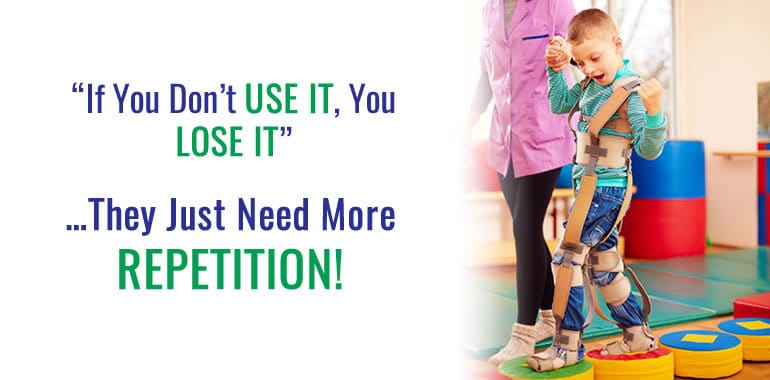
Let’s pause and think about this for a moment. You’ve probably heard the phrase, “If you don’t use it, you lose it,” right? When it comes to developing movement skills and building strength, the idea holds—except it’s not always about losing a skill, but rather never getting the chance to gain it in the first place.
If a child (or adult) doesn’t have the opportunity to explore movement—like sitting up on their own, crawling, or standing—it becomes much harder for them to achieve those goals. The key? Repetition. With the right support and the right setup, even individuals with the most significant physical or neurological challenges can gain new skills. They just need more chances to learn.
I always go back to this: a typically developing baby might need to push up on their arms a thousand times before they’ve mastered that skill. A child with a neurological condition? They might need ten times that amount of practice. This is why home exercise programs are so essential—and why limited therapy time might unintentionally slow their progress.
Exposure to new movements matters. Take a non-ambulatory child, for example. If they’re regularly exposed to walking practice—whether in a gait trainer or using a body-weight supported treadmill—they’re not skipping steps, they’re stimulating learning. Developmental milestones still matter deeply, and all of them need to be worked on. But introducing new positions and practicing them consistently is how the brain rewires and adapts—especially with neurological conditions.
Even children who can walk need consistent exposure to the specific skills they’re working toward. Whatever the goal is—better balance, improved coordination, greater independence—they won’t get there unless they’re actively doing that skill, again and again. Sure, there are other tools we use—strengthening techniques, movement breakdowns, therapeutic strategies—but nothing replaces the importance of repetition when it comes to learning.
It’s kind of obvious, and yet easily overlooked. We, as typically developing adults, are supposed to be moving our bodies at least 30 minutes a day for our own health. So why would we expect anything less—or even less often—for a child with a neurological condition?

Christine Astarita
She discovered her passion for the neurologic pediatric and adult population during her clinical affiliation at a special services school in Cape May, New Jersey. She is an active member of the APTA and continues to take post-graduate course work related to treatment methods for neurological diagnoses.