
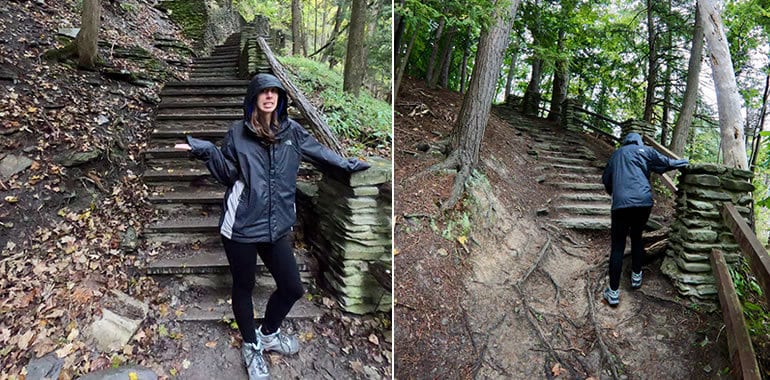
After running 26.2 miles in Corning, NY, I thought it’d be a great idea to go for a hike the very next day.
Spoiler alert: it was not.
Every step hurt. My muscles were sore, shaky, and not quite doing what I asked of them. I found myself awkwardly turning sideways on the trail steps, holding the railing with both hands, trying to get down without collapsing. That’s when it hit me:
This is exactly what I see our kids do in the clinic.
They’re not being dramatic. They’re not being lazy. They’re compensating—just like I was—because something in their body is making it harder to move safely or confidently.
When kids walk down stairs with hesitation, go sideways, or avoid leading with a certain leg, it usually comes down to two major reasons we see over and over at Breakthrough:
1. Limited Range of Motion (Especially at the Ankle)
A child might have difficulty bending or flexing their ankle due to past surgery, tightness, or contractures. This limits their ability to shift weight or adjust their body as they step down.
💡 What about braces?
Some orthotics—especially solid AFOs—hold the ankle at a fixed 90-degree angle. That helps with stability, but it completely blocks ankle motion. Try imagining your own ankle locked in place: stepping down would feel stiff, unbalanced, and awkward. You’d compensate, just like I did post-marathon.
2. Muscle Weakness & Poor Eccentric Control
Let’s rewind to my hike:
Why did I turn sideways going down the stairs?
Because my quads (those big muscles in the front of your thigh) were sore and weak, and I didn’t trust them to control the descent.
That’s called eccentric control—when your muscles slowly lengthen to support movement against gravity (like walking downhill or stepping down a stair). It’s the reason going down stairs is harder than going up.
When a child has weakness in one leg—or one side of the body, like in hemiplegia—they may:
- Avoid leading with their stronger leg because the weaker one can’t control the step down
- Step down quickly and without control
- Turn sideways to shift demand onto different muscles
Sound familiar?
So Why Does This Matter?
Stairs are just one example. Eccentric control is involved in tons of everyday movements—like sitting down in a chair, squatting to pick something up, or walking down a slope. That’s why we target these specific muscles and movements during therapy: so our kids don’t just get stronger, but learn to move more safely, confidently, and independently.
Sure, poor stair navigation can also be caused by balance or coordination issues (don’t worry, we’ll get into those in a future post), but limited range and eccentric weakness are two of the most common things we see every single day.
https://youtu.be/6unW4XcsSok
Check out the video above to watch the differences in stair patterns—and how I moved after my marathon. You’ll see the same patterns in our clinic, but for very different reasons.
Got questions about your child’s movement patterns, braces, or stair navigation? Reach out—we’d love to help you understand what’s going on behind the scenes and how to support your child’s independence.

Christine Astarita
She discovered her passion for the neurologic pediatric and adult population during her clinical affiliation at a special services school in Cape May, New Jersey. She is an active member of the APTA and continues to take post-graduate course work related to treatment methods for neurological diagnoses.